
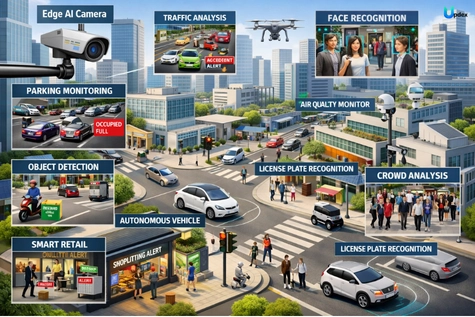
Artificial intelligence systems are evolving quickly, and developers today face an important architectural decision: should AI processing happen at the edge or in the cloud? This debate—edge AI vs cloud AI-has become especially relevant for India, where industries are increasingly deploying sensors, monitoring systems, smart infrastructure, and automation technologies.
As businesses adopt real-time analytics, surveillance systems, industrial automation, and smart city infrastructure, the choice between edge AI vs cloud AI determines how fast systems respond, how securely data is handled, and how cost-effective the deployment becomes.
For Indian developers and organizations building modern digital systems, understanding the differences between these two AI approaches is essential. The right choice can improve system performance, reduce operational costs, and enable scalable AI-powered solutions.
Understanding Edge AI
Edge AI refers to artificial intelligence processing that occurs directly on devices or near the data source, rather than sending data to centralized servers. These devices can include:
- IoT sensors
- CCTV cameras
- embedded systems
- industrial machines
- smartphones or edge gateways
Instead of transmitting raw data to the cloud, the device processes the data locally using AI models. This allows decisions to be made almost instantly, which is crucial for time-sensitive applications.
For example, a smart traffic camera installed at an intersection can detect traffic violations in real time without sending every video frame to the cloud. The AI model runs directly on the camera or local gateway.
This capability is why edge AI is rapidly gaining popularity in India, particularly in projects involving infrastructure monitoring, transportation systems, and industrial automation.
Understanding Cloud AI
Cloud AI works differently. In this model, data collected from devices or applications is transmitted to remote servers hosted in cloud platforms. Powerful data centers process the information using large AI models and then return results to the user or application.
Cloud AI platforms provide massive computational resources that allow developers to train and deploy sophisticated machine learning models.
Many widely used AI services today operate through the cloud, including:
- image recognition services
- large language models
- speech processing systems
- predictive analytics platforms
Cloud-based AI enables large-scale data analysis, which is particularly useful for applications requiring high computing power or centralized data processing.
However, this approach can introduce latency and bandwidth challenges, especially when dealing with high-volume real-time data streams.
Why the Edge AI vs Cloud AI Debate Is Growing in India
India is experiencing rapid digital transformation across industries. Smart infrastructure projects, digital highways, surveillance systems, industrial automation, and smart factories are all generating huge volumes of data.
Many of these systems require real-time decision-making, where even a small delay can reduce effectiveness.
For example:
- Traffic monitoring systems must detect violations instantly.
- Industrial sensors must detect machine failures immediately.
- surveillance systems must identify threats in real time.
Sending every piece of data to cloud servers can introduce delays due to network latency and bandwidth limitations. This is why edge AI deployments are increasing in Indian infrastructure projects.
At the same time, cloud AI remains essential for large-scale analytics, long-term storage, and model training. As a result, many modern architectures combine both approaches.
Latency: The Biggest Difference
One of the most important differences in the edge AI vs cloud AI comparison is latency.
Latency refers to the time it takes for data to travel from the source to the processing system and back.
Edge AI dramatically reduces latency because processing happens close to the data source.
For example, a factory sensor detecting overheating equipment must trigger an alert instantly. If the system waits for cloud processing, valuable seconds could be lost.
Edge AI systems can analyze the data locally and respond immediately.
Cloud AI, on the other hand, requires data to travel across networks before processing occurs. While modern networks are fast, they cannot always guarantee real-time performance.
For applications such as autonomous monitoring, traffic systems, and robotics, low latency is critical. This is where edge AI excels.
Privacy and Data Security Considerations
Privacy is another major factor in deciding between edge AI vs cloud AI.
When data is processed in the cloud, it must first be transmitted across networks and stored on external servers. This raises concerns about data security, especially when dealing with sensitive information.
Edge AI processes data locally, which reduces the need to transmit raw data externally. This can significantly improve privacy and security.
For example:
- CCTV systems can analyze video locally without sending footage to remote servers.
- healthcare monitoring devices can process patient data directly on the device.
This approach minimizes the risk of data leaks and ensures better control over sensitive information.
In sectors like healthcare, defense, and government infrastructure, local processing through edge AI is often preferred for security reasons.
Cost Considerations
Cost is another important aspect when comparing edge AI vs cloud AI.
Cloud AI services operate on usage-based pricing models. Organizations pay for compute resources, storage, and data transfer. For small workloads, this model is convenient and cost-effective.
However, when applications generate massive volumes of data—such as video streams from hundreds of cameras—the cost of transmitting and processing that data in the cloud can become very high.
Edge AI helps reduce these costs by filtering and processing data locally. Only important insights or summarized results need to be sent to the cloud.
This hybrid approach can significantly reduce bandwidth and storage costs.
However, edge deployments also require specialized hardware such as AI-enabled processors or edge computing devices. These initial hardware costs must be considered when designing the system architecture.
Typical Use Cases in India
Edge AI vs cloud AI are used in many Indian industries. Each approach serves different purposes depending on the requirements.
Infrastructure Monitoring
India is investing heavily in smart infrastructure projects. AI-powered monitoring systems are used in highways, bridges, railway networks, and public safety systems.
Edge AI allows cameras and sensors to analyze conditions locally and detect issues instantly.
For example, a highway monitoring system can detect accidents, traffic congestion, or dangerous driving behavior in real time.
Smart Transportation Systems
Urban traffic management is a major challenge in Indian cities. AI-powered traffic systems help regulate signals, detect violations, and monitor congestion.
Edge AI enables cameras and sensors to process video feeds locally and trigger alerts immediately.
Cloud AI can then analyze aggregated data to improve long-term traffic planning.
Industrial Automation and Smart Factories
Manufacturing facilities increasingly use AI-driven sensors to monitor equipment performance and detect anomalies.
Edge AI allows machines to detect faults instantly and prevent equipment failure.
Cloud AI platforms are often used to analyze historical data and optimize production processes.
Surveillance and Security
Public safety systems rely heavily on AI-powered surveillance. Processing high-resolution video in the cloud can consume enormous bandwidth.
Edge AI enables cameras to perform facial recognition, motion detection, or anomaly detection locally.
Only relevant alerts or clips are transmitted to central servers.
Agriculture and Environmental Monitoring
AI-enabled sensors can monitor soil conditions, water usage, and crop health in real time.
Edge AI devices deployed in rural areas can operate even with limited connectivity, making them ideal for agricultural monitoring systems.
Cloud AI can later analyze collected data to improve crop yield predictions.
How to Choose Between Edge AI vs Cloud AI
Choosing between edge AI vs cloud AI depends on the specific requirements of the project.
Developers should consider several key factors when designing their architecture.
Choose Edge AI When:
- real-time processing is required
- network connectivity is unreliable
- data privacy is critical
- bandwidth usage must be minimized
Edge AI is ideal for systems where immediate responses are necessary, such as surveillance cameras, autonomous sensors, and industrial monitoring systems.
Choose Cloud AI When:
- large-scale data processing is required
- complex AI models need powerful computing resources
- centralized analytics is important
- training large models is necessary
Cloud AI works well for applications like predictive analytics, recommendation systems, and large data platforms.
The Hybrid Approach
In practice, many organizations combine both edge and cloud AI to achieve the best results.
Edge devices perform real-time inference and filtering, while cloud platforms handle heavy data processing and long-term analytics.
This hybrid architecture provides:
- low latency from edge processing
- powerful analytics from cloud computing
- optimized cost and bandwidth usage
Many modern AI systems in India are moving toward this edge-cloud hybrid architecture.
Future of Edge AI in India
The demand for edge AI is expected to grow rapidly as India expands its smart infrastructure, industrial automation, and IoT ecosystems.
Several trends are driving this growth:
- expansion of IoT devices and sensors
- deployment of 5G networks
- growth of smart cities
- rising demand for real-time analytics
As edge hardware becomes more powerful and affordable, developers will increasingly deploy AI models directly on devices.
At the same time, cloud AI will remain essential for large-scale data processing, model training, and enterprise analytics.
Conclusion
The debate around edge AI vs cloud AI is not about choosing one technology over the other. Instead, it is about selecting the right architecture for the problem being solved.
Edge AI offers real-time processing, improved privacy, and reduced bandwidth usage, making it ideal for infrastructure monitoring, smart transportation, and industrial automation.
Cloud AI provides scalable computing power and advanced analytics capabilities, making it essential for large-scale data analysis and machine learning model development.
For Indian developers working on modern AI systems, the most effective approach is often a hybrid architecture that combines edge intelligence with cloud computing power.
Understanding the strengths and limitations of each model will help teams build smarter, faster, and more efficient AI-driven solutions for the future.
Fast and trusted updates from Updex